Facebook Advertising: Beyond the Click
 |
 |
| Monthly Unique Visitors -comscore.com |

eMarketer has predicted a 39%increase in ad spend on Facebook in 2010. This maybe an underestimate considering the vast increase in users globally engaged with Facebook. I believe in Facebook advertising for a few reasons:
- It offers unparalleled targeting for niche advertising
- It provides rich data about audience behaviour
- It builds brand awareness
- It offers reasonable CPC rates and measurable CTR
For advertisers Facebook ads provide a lot of market intelligence about the size of the target market on Facebook even before an ad order is placed. In my opinion the real value in Facebook advertising isn't the click throughs. The more I look into Facebook advertising the more diverse benefits I have discovered for advertisers beyond the click.
5 Reasons to use Facebook Advertising
Advertising on the web is growing increasingly complex and diverse. From pre-roll ad spots on WebTV to Interactive web overlays, Facebook campaigns and social experiments the landscape of advertising on the web is changing quickly. Attention is the new currency but what are the new billboards on the social web? Facebook ads of course. Here are my top five reasons to put up yours:
Incredible Targeting
Facebook's targeting system is good and getting better. It recently added more cities and broke down large cities into their suburban parts. You can also target 'friends of fans' if you have a page. This posts your ad with a reference to someone who the target knows who already 'likes' (this is the new word for being a fan) your page.
Exposure is 'Free' with CPC
On Facebook you can choose between cost-per-click (CPC) advertising or cost-per-mille (CPM) or a thousand impressions. When you choose CPC there are many things you can do to improve the value you receive from the ads. If you are a known brand use a logo and not a picture, this will leverage your brand power and cut through the spammy ads. If you are advertising an event be sure to include all pertinent info: what, when, where and how much to ensure that people who can't or won't attend don't click the ad, more on that another time.
I also recommend adding a custom shortened link to the end of your ad copy so that people can check your link later if they want, this will not cost you anything. I have never used CPM as I don't believe it provides enough value for brands that aren't huge. I have heard evidence both ways on CPM.
Great Information about clickers
Facebook will tell you the age and sex of the people who saw your ad and clicked it as well. They also provide information about what clickers favourite Books, TV, Music and Movies are as you can see in another post. If you use bit.ly or j.mp to shorten your destination link it will tell you what Facebook app, page or profile people were browsing when they clicked your ad. This includes more information than Facebook would like to give advertisers. Take a look:

This is a tiny portion of that list and if you have the chance check out someone else's campaign results to get the full picture. You can see the data for anyone's j.mp or bit.ly link by adding + to the end of it (IE: http://j.mp/kmay20 > http://j.mp/kmay20+).
Build Brand Awareness
Facebook ads (CPC) increase brand awareness even when people don't click. When I talk to students I often ask how many of them have read a Facebook ad and not clicked it and the vast majority put up their hands. Ask yourself the same question and don't ask yourself if you ever read one ask yourself if you've even 'seen' one. This is how Facebook ads operate like a social billboard. When people see just your brand or logo on Facebook that increases awareness in the minds of the audience. This is key because people aren't in a buying frame of mind when they use Facebook but you still want your brand to remain top of mind when that audience turns to Google when they're ready to buy.
Leverage your Page "Friends of Fans"
I talked about this a little off the top but this may be one of the most effective tools for leveraging your brand's connections. Check Facebook Ad reports which can give you audience and responder information that offer insights both into general user tendencies(the younger they are the more often they click) and the specific tendencies of your market. For example when my ads target 'friends of fans' Men 35-44 have a click through ratio (CTR) that is five times higher when not targeting 'friends of fans'.
5 Reasons to use Facebook Advertising
Advertising on the web is growing increasingly complex and diverse. From pre-roll ad spots on WebTV to Interactive web overlays, Facebook campaigns and social experiments the landscape of advertising on the web is changing quickly. Attention is the new currency but what are the new billboards on the social web? Facebook ads of course. Here are my top five reasons to put up yours:
Incredible Targeting
Facebook's targeting system is good and getting better. It recently added more cities and broke down large cities into their suburban parts. You can also target 'friends of fans' if you have a page. This posts your ad with a reference to someone who the target knows who already 'likes' (this is the new word for being a fan) your page.
Exposure is 'Free' with CPC
On Facebook you can choose between cost-per-click (CPC) advertising or cost-per-mille (CPM) or a thousand impressions. When you choose CPC there are many things you can do to improve the value you receive from the ads. If you are a known brand use a logo and not a picture, this will leverage your brand power and cut through the spammy ads. If you are advertising an event be sure to include all pertinent info: what, when, where and how much to ensure that people who can't or won't attend don't click the ad, more on that another time.
I also recommend adding a custom shortened link to the end of your ad copy so that people can check your link later if they want, this will not cost you anything. I have never used CPM as I don't believe it provides enough value for brands that aren't huge. I have heard evidence both ways on CPM.
Great Information about clickers
Facebook will tell you the age and sex of the people who saw your ad and clicked it as well. They also provide information about what clickers favourite Books, TV, Music and Movies are as you can see in another post. If you use bit.ly or j.mp to shorten your destination link it will tell you what Facebook app, page or profile people were browsing when they clicked your ad. This includes more information than Facebook would like to give advertisers. Take a look:

This is a tiny portion of that list and if you have the chance check out someone else's campaign results to get the full picture. You can see the data for anyone's j.mp or bit.ly link by adding + to the end of it (IE: http://j.mp/kmay20 > http://j.mp/kmay20+).
Build Brand Awareness
Facebook ads (CPC) increase brand awareness even when people don't click. When I talk to students I often ask how many of them have read a Facebook ad and not clicked it and the vast majority put up their hands. Ask yourself the same question and don't ask yourself if you ever read one ask yourself if you've even 'seen' one. This is how Facebook ads operate like a social billboard. When people see just your brand or logo on Facebook that increases awareness in the minds of the audience. This is key because people aren't in a buying frame of mind when they use Facebook but you still want your brand to remain top of mind when that audience turns to Google when they're ready to buy.
Leverage your Page "Friends of Fans"
I talked about this a little off the top but this may be one of the most effective tools for leveraging your brand's connections. Check Facebook Ad reports which can give you audience and responder information that offer insights both into general user tendencies(the younger they are the more often they click) and the specific tendencies of your market. For example when my ads target 'friends of fans' Men 35-44 have a click through ratio (CTR) that is five times higher when not targeting 'friends of fans'.

I wanted to add some final insights from my Facebook advertising experiences. Sending someone from an ad to a Facebook page or event is more successful than sending them to a generic webpage. Create a custom landing page on your site if you are planning to spend $1000+. Try Facebook advertising with variations in ad copy, ad image and targeting and you can discover a lot of information about your target audience habits, likes and dislikes.

Join competitors Fan pages, the bigger the better. Then take note of which items receive the most community engagement. Is it deals? Ideas? Advice? Use this and test what works on your page by watching to see what types of content your audience engages with.
Lastly, by searching through the sea of public data on facebook for brand, competitor and market chatter valuable market and competitive intelligence can be found. All of this takes time and experience. Analysts of consumer behaviour and people who understand how to read the rich data that is delivered by Facebook and others will find major benefits. What do you think? Should this have been more than one blog post?
Social Media Success: An Interview with Marc Smith


A large number of users are gaining great advantage personally, professionally and otherwise from their active use of social media tools to connect, share and learn. Marc Smith of Amuse Consulting is one of those people and I took some time to ask him about what's worked for him. Today is the 5th anniversary party of @amuseconsulting and Marc is throwing one hell of a party later this evening, but I got to ask him about what's worked for him before things got wild (UPDATE: The party was a great time and showcased the little touches that take a event from ordinary to extraordinary.

Before using social media Marc used a strong arsenal of tools to promote his business including: personal networking, a website, word of mouth, monthly e-newsletters and joining associations like Business Network International. Marc has been using Facebook for almost five years but didn't really know what the benefits for his business were until friend and YouTube specialist @JoshRimer sold him on them.
He said that they were free tools and that they are just an extension of the relationship marketing that I was already doing. I was also enticed by the possibility to target categories and markets through social media versus going to networking events where it's often a 'crap shoot'. In Social media I could seek out my targets whereas at networking events I was relying on other people to come to those events where I would then have the opportunity to meet them. - Marc Smith on why social media is superior for him.
I frequently use a story I heard about Marc as an example of what kind of things work for building connections and community. In the story Marc has a coffee everyday with someone new. Often those are people he met through social media.
ME: How did you come up with this idea? How has it helped your business and you?
ME: How did you come up with this idea? How has it helped your business and you?
MARC: It's part of what I do. I used it to build my community personal, professional or any other. No one will hire me if they didn’t know who I am therefore the more people I met the more opportunities for business I would have. I used to work at Caper’s then struck out on my own. In the last year with the Social media explosion the real benefit has been that people are now calling me to have coffee with me to share their business with me. The roles have reversed. I always say yes because you never know what benefits those conversations can reveal for your business. It expands opportunities for business and it expands the products/services I can offer to clients because I know of their existence. Sometimes taking something new to event planning can be that competitive edge, IE mobile apps for events.
I am an open source program. -Marc Smith

What has the ROI been for you in using social media?
It’s been a 300-500% on the investment of my time. Social media use has created opportunities for me to speak, to reach new customers, and it’s probably doubled my profile in the last year. A website or going to an event is a onetime thing whereas Twitter and Facebook allow me to interact with people on a regular basis to stay top of mind and create more business opportunities. It keeps me relevant.
How has using social media enhanced your life beyond business?
I’ve made some really interesting friends. It’s provided more opportunities to speak to young entrepreneurs. It’s allowed me give back to my community more by supporting charity and grassroots events.
What is the most unexpected thing you have found since splashing into the social media world?
How many people are social online and unsocial offline? It’s hard to tell what someone truly through a digital avatar is. I am as social offline as I am online and for others this may not be the same.
Did you teach yourself everything you know about social media?
It was all learned through social engagement. @ShaneGibson and @IanWatt were a few of the people I met in the early stages. Everyone along the way has given me bits and pieces. I try and explain the big picture to people. A lot of it was trial and error and also a lot of anecdotes. I think I followed the right people in the early stages and that quickly advanced my learning. Instead of spending a few minutes getting started I spent a few hours and began to find out how the services best work. Twitter has been the most successful for me. Although I use Facebook and LinkedIn as well.
5 Rules for being an Entrepreneur - Marc Smith
- Be the right person for the business you’re going to be in.
- Be self aware. Know your strengths and weaknesses. What makes your day better or worse.
- Don’t do things that don’t make you money (outsource, outsource, outsource) All the things that I am not good at or are not my core strengths take a lot more mental time away from the things you are good at. It has a much higher ROI.
- You are never busy enough. You always have to leave time for networking, marketing, building sales or acquiring jobs. Relying on a single client can leave your business in the wind.
- Even solo entrepreneurs are never alone. Make sure you have a network of people who want you to succeed behind you. You need a shoulder to cry on and someone to bring you down to earth when you are doing really well. (This is most important). No one looks out for you more than your family and friends when you are starting a business.
5 things every entrepreneur should know about social media
Freelance Camp: Intellectual Property


 Minna asked me to speak about intellectual property theft online and what to do about it when it happens. I recently had and blogged about an experience having my intellectual property stolen. To me stealing doesn't happen until someone uses my creation to try and profit without credit to me. I am happy to share for the purposes of education, but I am not happy when someone takes that spirit for granted and tries to profit from it. Please read the original story or proceed without context ;)
After I blogged about the theft and filed a copyright complaint with Slideshare; the offender, who I had warned twice previously by leaving a comment on the presentation, began contacting me via email. He was contacting me because Slideshare had suspended his account and ultimately deleted his entire document collection. He also tried to add me to LinkedIn and Facebook. I politely declined, but I wanted to share the email thread with you dear readers as the friends who I sent the emails to thought it was too good to keep locked up. So for your reading pleasure here is the email thread in the order it was received:
On Fri, Apr 30, 2010 at 5:42 AM, Ali Hadi wrote:
Dear Kemped Monds
You've some misunderstanding, let me clear you that presentation readjusted with new visual effects just for training purpose not for selling purpose. It's my humble request to understand the value of information "sharing", I just offered people to learn about "big three" attend workshop $100 that doesn't mean selling the presentation. Hope you'll understand and remove all your negative comments which is very bad word of mouth for me.
It's my request to understand the benefits of information, although I did mistake without your permission revise the presentation and change all visual effects. "SORRY for that"
Regards,
Ali
On Fri, Apr 30, 2010 at 6:08 AM, Ali Hadi wrote:
I just talked again to my web-developer who did it, I mean who design this presentation for me and he accepted he did it just for training purpose not for selling purpose. So try to understand we didn't sell your presentation just change visual effects and content to create hype n traffic for our FREE workshop.
Hope you understand our situation, we believe in sharing not in theft or misuse of material.
Thanks,
Ali
On Fri, Apr 30, 2010 at 6:27 AM, Kemp Edmonds wrote:
Resolution will come when every slide I created has my name on it. Until then I will continue with my complaint. I now understand what your team did on your end. You must know that as a "Social Media Company" using other's work without crediting or refering to them is a major mistake
If the presentation is altered to credit me for the content and my name appears at the bottom of each slide and in the first slide as the author I will be satisfied. I also believe in sharing but there is a right way (with permission and attribution and not for financial gain unless u pay the creator) and a wrong way to sharing this kind of information.
Thank you for finally contacting me personally and I hope you take the time to resolve this as I have requested. Deleting my comments and hiding the presentation was cowardly.
Kemp Edmonds
On Fri, Apr 30, 2010 at 6:32 AM, Ali Hadi wrote:
OK, I promise with you! I'll embed original link of your presentation and courtsey by your name on each slide "Kemp Edmond".
I'm again very very SORRY on behalf of my team, hope we'll both take positive benefits from networking and learn from each other, I know your positive man and understand my situation.
My slideshare account blocked and my all real professional work blocked, plz do me a favor send email to Rashmi and Jonathan [Jonathan and Rashimi are the principals at Slideshare] to restore my account, I will be thankful to you.
Best Regards,
Ali
On Fri, Apr 30, 2010 at 6:42 AM, Kemp Edmonds wrote:
It's Kemp Edmonds.
I am positive and this is a learning experience mostly for you and your company. Pakistan may be on the other side of the world but the global village is tiny and I will NOT be contacting Jonathan or Rashimi. You may send them a copy of our correspondence and have them contact me to verify my wishes but this must go through the proper process. Had you acted more quickly to contact me I would not have taken the time to file the complaint.
I hope this has been a learning experience for yourself and your employees.
I am sorry for the inconvenience and negative press or word of mouth you may receive from this experience and the subsequent consequences from Slideshare but that is the price you have to pay for allowing your employees to publish the work of others as your own and allowing them to publish online under your name.
The world will become increasingly small in the years to come and learning what not to do now is a valuable lesson.
Sincerely,
Kemp Edmonds
On Fri, Apr 30, 2010 at 6:50 PM, Ali Hadi wrote:
Dear Brother!
I'm completely agree with you but I lost my 85 slides, most of my best work which I have done in last one year. Don't know slideshare team restore my data because last time my system reinstalled and I lost of presentations and projects, please do me favor to email or fax again to Rashmi to recover my data although I have sent your text through facebook inbox to Rashmi and finding again Jonathan ID online.
We'll work together in future on many projects and ideas, I'm sure we'll do much better..I myself believe in sharing and good human relationship.
I really appreciate your kind support and your positive action!
Have a great day ahead
On Fri, Apr 30, 2010 at 6:53 PM, Kemp Edmonds wrote:
Your data is safe and currently under review by SlideShare they did not delete your content but they may review other presentations for plagiarism. This has already been enough of a hassle for me so I will not be initiating any action to aid you. You must be the one to deal with the consequences of your actions and if that means losing all of your presentations then I am truly sad for you, but it is not my job to fix your mistake.
I would apologize here but this is your bed and you must sleep in it and learn from it.
On Fri, Apr 30, 2010 at 7:00 PM, Ali Hadi wrote:
Thanks again! Hope you'll remove from your blog and website the word you use about my name and company.. plzzzzzzzzzzzz remove it. I will be grateful to you, Always at your service with mind set...my friend.
Good Luck in your every endeavor.
Ali

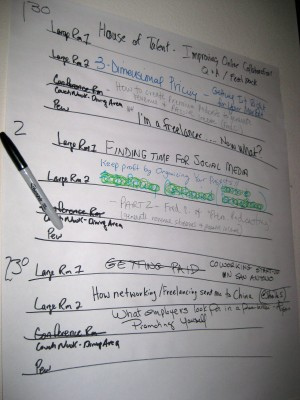
Please join me and many other Freelancing professionals May 29th at the Network Hub for an amazing day of discussion, sharing and learning in downtown Vancouver.
This is what I love about events like Freelance Camp and BarCamp:
 |
| Speakers are chosen democratically |
Understanding Social Networks: Frequency


Last month I discussed understanding social networks with a focus on delivery. I continue to see lots of people cross posting from Twitter to LinkedIn, something that I consider to be a bad move due to the nature of the different audiences on each social network. Today let's discuss something with even less hard and fast rules than delivery: Frequency. We've all had someone in our online social network who updates their status too much or with items we don't find interesting. I am sure I have been that person before (please let me know with a comment below, thanks). On LinkedIn most of your network is professional and oriented towards different goals and habits than on Twitter or Facebook. Here's an example from LinkedIn today:

To be kind to friends and connections I have blacked the cross posters' information. As you can see these folks are cross posting from Twitter. I already get these messages on Twitter from these people. I used the colored dots in the top right of the updates to identify the same user's updates. The frequency of these people's tweets is preventing me from viewing as many different LinkedIn updates as I would like. I see the same people constantly in my LinkedIn updates section.
The frequency of tweets (1-20/day) is very different than the usual frequency of LinkedIn updates (1-3/week). I know I am going to get into a bit of hot water here as everyone has different ideas about how often updates should be made on different social networks. There are NO hard and fast rules here, but when people ask me how frequently they should post I give them this list:
 |
| My Twitter Stats from tweetstats.com |
These are frequencies I recommend using for posts. What do you recommend or use?
We are all busy and seeing things we aren't interested in can turn people off, consider how easy it is to "unfollow" on Twitter or "hide" on Facebook. This is why it is so important to understand and respect each audience for their differences in the frequency and delivery they expect.

Virtual Economies: Gaming and Gambling

 |
| The Second Life Economy |
 |
| Buying Farmville cash or coins |

The boy's mother's credit card was billed $1000 while the child's savings account was emptied of $400. A spokesperson for the mother's credit card company indicated "that had the expenditures been on a gambling site the escalating transactions would have raised warning flags, but since the purchases were technically Facebook Credits, they didn't warrant suspicion". When do online purchases raise warning flags? How are regulators and businesses like Facebook protecting children from this? They're not.

Gambling isn't only bad for kids who do it; it's also bad for kids whose parents do. This demonstrated by the record numbers of children being left in vehicles outside of Casinos around North America (see this exhaustive list of examples from a Massachusetts site against slot machines).
Today thousands of dollars can be gone in a matter of hours through virtual transactions. A debate rages in the UK around whether or not these virtual worlds should be regulated by gambling laws that govern the winning of funds in real life. Some online worlds have entire task forces dedicated to the removal of real currency trading in their worlds. Virtual economies often result in interaction with the 'real' economy as characters, spells and items are sold on sites like eBay for real money thus getting around 'task forces' trying to remove real currency from in-game transactions.
 |
 |
| A gold farm in China |
On Second Life a group of users recently filed a land claim suit against Linden labs, the game's creator, for deceiving users about their ownership of the game's virtual property. This April 2010 case uses the precedent set in the 2007 case of Bragg V. Linden which has been cited in a number of articles and research papers from "Virtual World End-User License Agreements" to "User-Generated Content and the Future of Copyright". The rights of users to the virtual property they purchase or create are being established through these precedent setting lawsuits. Are these users gambling or are they gaming?
The lines between gaming and gambling are increasingly blurring and the speed of regulatory change will not help the young people who are currently addicted to Farmville, Second Life or World of Warcraft. Playing video games casually, less than 3 hours a week, can be good for social skills, problem solving and relaxation. Problems arise when we see people, particularly young people, playing excessively in an addictive manner. If you are addicted to a virtual economy where you continually exchange money for virtual goods are you a gambler or a gamer?

This convergence of virtual and real economies in our world speaks to larger questions about jurisdiction and the Internet. Who controls the online economy and the ability to tax it when physical borders are no longer part of the equation? If there is a black market for virtual goods is that virtual property taxable? Is the government right to spend millions to recover millions from these emerging economies? How can they regulate and monitor these worlds? Regulators from the UK, US and Canada are pushing to have the onus put on those who manage the virtual worlds and games to submit income statements for users. The potential tax revenue is huge estimated to be $30 billion by 2012 (up from $21 billion in 2008).
The stories lead from one to another and the amount of regulatory change we will see in the next 5 years will be enormous and bureaucratically prohibitive (it will take a long time). I have listed some related stories I found in my search for information on this story:
- Governments eye online gaming as a revenue source -KPMG Report.
- Is Second Life being used for money laundering? -alphavilleherald.com.
- How has social network gaming become so big so fast? -nma.co.uk
- UK social networking sites may lose online gambling ads -gamingzion.com
- UK minister suggests changes to gambling laws -legalbytes.com
- Why people pay for virtual goods -gamesbrief.co.uk
- Virtual Goods, Virtual Economies, Gold Farming, Second Life, World of Warcraft -Wikipedia.org

Subscribe to:
Posts (Atom)


